AI assistants are quickly becoming the go-to way customers find information. Instead of scrolling through pages of results, they expect clear, direct answers. To be included in those answers, your business content needs to be organized, structured, and machine-readable.
That’s where tools like ChatGPT-5 and Claude can help. They aren’t just assistants for answering questions-they can also serve as powerful partners in turning your raw material into structured content that AI systems can easily surface.
Using LLMs to Build Structured Content
From Notes to FAQs
Feed meeting notes, product specs, or customer service logs into ChatGPT-5 or Claude and ask:
“Convert these into FAQs with schema.org markup and concise, plain-language answers.”
This process turns unstructured text into structured Q&A blocks that AI assistants love.
Organizing Documentation
Claude’s long-context ability makes it ideal for taking large, messy documents and breaking them down into sections:
“Organize this documentation into Installation → Configuration → Troubleshooting.”
The result is an easy-to-navigate structure for both people and machines.
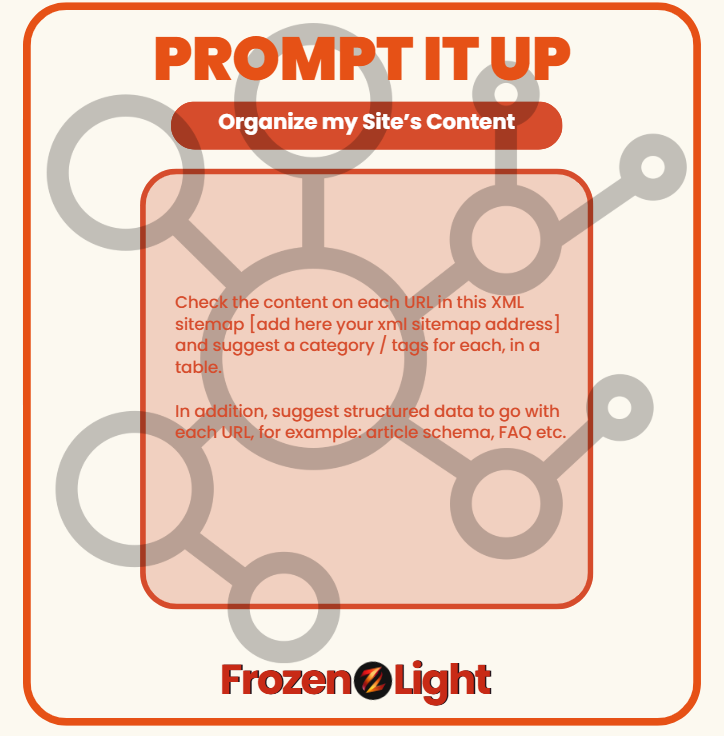
Just as well one can organize a whole website by asking the following:
check the content on each URL in this sitemap and suggest a category / tags for each, in a table.
In addition, suggest structured data to go with each URL, for example: article schema, FAQ etc.
Creating Knowledge Graphs
Ask ChatGPT-5 to pull out relationships:
“Identify entities (products, features, benefits) and express them in JSON-LD format.”
That output can become the backbone of a knowledge graph, making your business easier for AI to understand.
Refreshing Content
Both ChatGPT-5 and Claude can suggest updates to keep your content current:
“Suggest quarterly updates for this FAQ page based on industry changes and user questions: [add your FAQ page URL here]”
Freshness is a signal AI systems weigh heavily when deciding what to show.
To get the most accurate refresh, provide the LLM with a list of trusted resources it should extract updates from.
From Structured Content to Precise AI Interaction (How We Build Our Bots at Frozen Light)
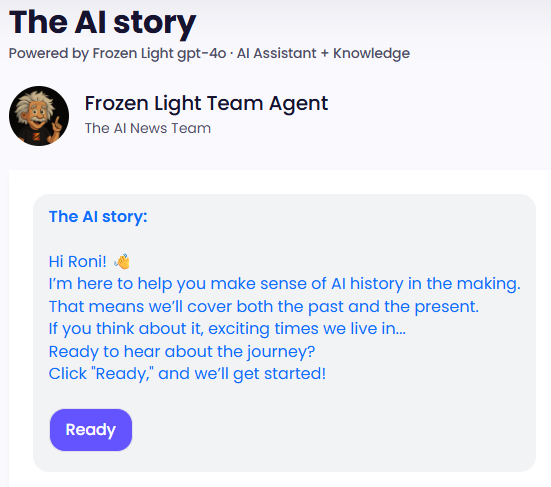
At Frozen Light, we believe that responsible AI starts with structured content and strict response logic. That’s exactly how we built the AI Story Bot - our trivia chatbot that answers factual questions about artificial intelligence with clarity and confidence.
Our bots are desinged to be both informative and disciplined.
Built on Structured Content
Every piece of information in our bot is pre-formatted as a Q&A pair. The structure is deliberate:
- One question per document
- Answer follows immediately after
- No room for freeform guessing
Why? Because bots hallucinate when content is vague or loosely organized. We wanted answers that are consistent, explainable, and grounded in fact.
Instructions That Enforce Precision
We don't let the bot "think" like an open-ended LLM. Instead, we give it very specific rules:
1. When a user asks a question:
Search for a single document where the first line matches or closely resembles the question.
2. Once a match is found:
Return only the content that follows. Nothing more. No invented answers. No speculation.
This restriction is intentional. It limits the bot to our curated knowledge base, ensuring every response is sourced, safe, and scoped.
The Result? Trustworthy AI Conversations
By combining AI tools like GPT-4 with highly structured content and strict retrieval logic, we’ve built bots that do more than chat - they teach, clarify, and build trust.
Whether you’re asking “Who is the father of AI?” or “Why is ChatGPT called ChatGPT?”, you’ll get a direct, vetted answer - and nothing else.
It’s one small example of how we believe AI should behave: smart, but also grounded.
Steps to Try Today
|
Goal |
What to Ask ChatGPT-5/Claude |
Output |
|
Create FAQs |
“Turn these notes into 10 FAQs with schema.org markup.” |
AI-friendly Q&A |
|
Simplify guides |
“Rewrite this 3,000-word article into step-by-step instructions.” |
HowTo content |
|
Map entities |
“Extract products, features, and benefits and output in JSON-LD.” |
Knowledge graph |
|
Keep content fresh |
“Suggest content updates based on the past 3 months of news.” |
Updated, relevant narratives |
With ChatGPT-5 and Claude, you can transform unstructured text into FAQs, guides, and knowledge graphs that AI assistants prefer. The payoff is visibility: if your data is structured, you’ll have a much higher chance of being featured in AI chat answers.
👉 Structured content is no longer optional - it’s your ticket to being part of the AI conversation.